Wednesday, July 20, 2011

Tessellations (1512)

A tessellation is a pattern of geometric patterns that fill a plan with no overlaps or gaps. One of the most famous contributors was Dutch artist, M. C. Escher. Tessellations are a great way to bring in a variety of subjects areas into a single lesson plan. Students are able to work with different geometric shapes they may have learned about, while also experiencing patterns first hand.


Tessellations can also help students make connections to real world examples. This could include tiling on the ground or a building, even the design in a quilt. It is important that students see examples of real life tessellations.


Giving students the opportunity to create their own tessellation is a great way for students to express themselves. This is a great time for art to be brought into the math classroom. It is not very often that this can be done so effectively.

Fractions (1510)

While working with fractions this last week, I realized how much I had forgotten from grade school. I was under the assumption that multiplying and dividing fractions would be a breeze for me. I was completely wrong on that. I believe the difficulty that I had throughout this chapter was largely related to my calculator use. I have become very dependent upon a calculator, which resulted in a loss of many of my basic math skills.

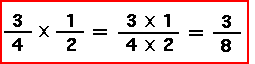
For both multiplying and dividing fractions, it really helped me to have an example right in front of me. The examples allowed me to see how the formula would be set up, and then I could just plug my numbers right in. This first image depicts the procedure for multiplying fractions.

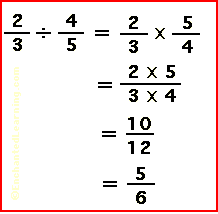
I used this following example to show me the procedure for dividing fractions. The trickiest part for me was to remember to cross multiply. Never forget, it is only practice that can help you improve.

Divide Fractions


Sunday, July 17, 2011

Who was Pythagoras? (1512)

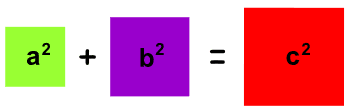
Who would have guessed that given a right angled triangle, you only need to know the lengths of two sides to figure out the length of the third? This relates directly to the Pythagorean Theorem. The theorem is named after the Greek mathematician Pythagoras who discovered it and it's proof.
a2 + b2 = c2

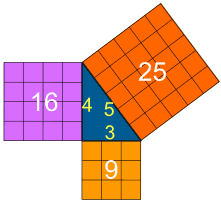
If a triangle contains a right angle (90 degrees), you are able to make a square on each of the three sides. The biggest square will be the exact same size as the two smaller squares put together. The following picture illustrates this fact.
pythagoras theorem
Let's check if the areas are the same:
32 + 42 = 52
Calculating this becomes:
9 + 16 = 25
It works ... like Magic!

 
The two shortest sides of the right angled triangle are called the legs (a & b). The longest side is considered the hypotenuse (c). The square of the hypotenuse is is equal to the sum of the squares of the two legs. Math is simply amazing!


Thursday, July 14, 2011

Greater Than.. Less Than.. (1510)

Distinguishing between the less than and greater than symbols can be tricky for students. I do not blame them though; the symbols < and > are very similar. The "less than" sign can be used to show that one value is smaller than the other, such as 3<5. The "greater than" sign is then used to show that one value is larger than the other, 6>2.

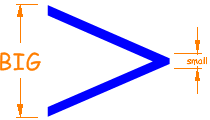
There a few learning techniques that can help students to remember the differences between the two. Looking at the picture below can help teach students that the small end always points to the small number, and the big end opens up to the big number.
greater than sign

Another common approach to these two tricky symbols references an alligator. The alligator method uses the symbols as a representation of an alligator mouth. The alligator allows wants to eat the larger number, so it will be opened up towards the larger number.   
*Alligator Tune (try this in your class to help students remember)


Friday, July 8, 2011

Make Time for Humor (1512)

I believe that humor is one of the most underrated methods to help students learn. Incorporating humor into the classroom is a great first step to creating a more positive learning environment. Wouldn't you be more excited to attend class if you knew that you might get a little giggle from what the instructor has to say?

I think the student and teacher relationship is changed when the instructor has a great sense of humor and uses it. With a little humor in the classroom students are able to relax and often pay attention more closely. Let's say you make a mistake, be able to laugh about it or make a joke. Students can learn from you that it is ok to take chances or even sometimes make mistakes.

Try to add a little humor to your students' day as well as your own. Tell a joke, show a cartoon, or play a funny video. A little laugh can go a long way in the classroom.

Wednesday, July 6, 2011

Number Theory (1510)

Number theory can be described as the study of the properties of natural numbers. Natural numbers are often times called whole numbers; this includes all positive numbers. Who knew that there were so many different ways to describe and define what I have always just called numbers?

In a multiplication problem two numbers are multiplied together (factors) to produce an answer (multiple). For an example look at the math problem 2*6=12. The numbers two and six are factors of twelve, and twelve is a multiple of two and six.

Factors of a number can be found by dividing. There are numerous methods to help discover all of the factors of a particular number. The one I have discovered to be most helpful to myself is factor trees. Below are two examples of factor trees; the first shows factorization for the number 48, and the second for the number 36.


Thursday, June 30, 2011

Triangles in Basic Geometry (1512)

Who would have guessed that there are at least six different names that triangles can be classified into. This was one section of the geometry unit that came back to my memory very quickly. I think the most difficult for me to remember though is the scalene triangle, having no congruent sides.

Two triangles can be considered congruent when corresponding sides and interior angles are congruent.It is not always necessary to look at all three sides and three angles. Instead, you are able to use postulates to determine the triangles to be congruent or not.

Three triangle congruence postulates are The Side-Side-Side (SSS), The Side-Angle-Side (SAS), and The Angle-Side-Angle (ASA). The image below shows two triangles that are congruent. This can be proven using the postulate SSS. The three sides of one triangle are congruent to the three sides of the other triangle.